
Saint-Pardon tidal bore 2026: dates, times and where to watch the wave

Picture a wave travelling up a river, against the current, rippling the water for kilometres. It exists, and the best place in France to watch it is twenty minutes from Domaine du Dahu: the Saint-Pardon tidal bore — the mascaret — on the Dordogne. Here is the official 2026 calendar of passages, morning and evening times, and everything you need to know so as not to miss it.
2026 calendar: dates and passage times at Saint-Pardon
The table below reproduces the official calendar from Vayres town hall for 2026. It only lists spring-tide days when the wave is visible. For each day: coefficient and estimated passage time at the port of Saint-Pardon, morning then evening. Times are indicative (± 15 min depending on wind and river flow): be there 30 minutes early.
coefficient ≥ 100: exceptional 90-99: fine wave < 90: modest wave
January 2026 · 9 passages +
| Day | Morning | Evening |
|---|---|---|
| Sat 3 | 88 3:31 | 91 16:06 |
| Sun 4 | 94 4:23 | 95 16:58 |
| Mon 5 | 96 5:12 | 95 17:46 |
| Tue 6 | 93 5:59 | 91 18:32 |
| Wed 7 | 87 6:43 | 82 19:14 |
| Tue 20 | 81 5:06 | 83 17:30 |
| Wed 21 | 84 5:43 | 85 18:06 |
| Thu 22 | 85 6:19 | 84 18:42 |
| Fri 23 | 82 6:55 | 80 19:18 |
February 2026 · 11 passages +
| Day | Morning | Evening |
|---|---|---|
| Sun 1 | 84 3:28 | 89 16:03 |
| Mon 2 | 94 4:17 | 97 16:50 |
| Tue 3 | 99 5:03 | 99 17:33 |
| Wed 4 | 99 5:44 | 97 18:12 |
| Thu 5 | 94 6:23 | 90 18:49 |
| Tue 17 | 82 4:12 | 87 16:34 |
| Wed 18 | 91 4:48 | 94 17:10 |
| Thu 19 | 96 5:24 | 97 17:45 |
| Fri 20 | 97 5:59 | 96 18:20 |
| Sat 21 | 94 6:34 | 91 18:54 |
| Sun 22 | 86 7:11 | 81 19:31 |
March 2026 · 13 passages +
| Day | Morning | Evening |
|---|---|---|
| Mon 2 | 84 3:18 | 90 15:49 |
| Tue 3 | 94 4:03 | 97 16:31 |
| Wed 4 | 99 4:44 | 99 17:09 |
| Thu 5 | 99 5:21 | 97 17:45 |
| Fri 6 | 94 5:56 | 91 18:17 |
| Sat 7 | 86 6:28 | 81 18:47 |
| Wed 18 | 87 3:44 | 92 16:05 |
| Thu 19 | 97 4:22 | 101 16:42 |
| Fri 20 | 103 4:59 | 104 17:18 |
| Sat 21 | 104 5:36 | 103 17:54 |
| Sun 22 | 100 6:13 | 95 18:31 |
| Mon 23 | 89 6:52 | 82 19:10 |
| Tue 31 | 82 3:57 | 86 16:25 |
April 2026 · 12 passages +
| Day | Morning | Evening |
|---|---|---|
| Wed 1 | 89 4:39 | 92 17:04 |
| Thu 2 | 93 5:18 | 93 17:40 |
| Fri 3 | 93 5:53 | 91 18:13 |
| Sat 4 | 89 6:26 | 86 18:43 |
| Wed 15 | 73 3:26 | 81 15:49 |
| Thu 16 | 87 4:08 | 93 16:29 |
| Fri 17 | 97 4:50 | 101 17:10 |
| Sat 18 | 104 5:31 | 105 17:50 |
| Sun 19 | 104 6:12 | 102 18:30 |
| Mon 20 | 99 6:54 | 94 19:11 |
| Tue 21 | 88 7:37 | 81 19:54 |
| Thu 30 | 80 4:10 | 81 16:33 |
May 2026 · 8 passages +
| Day | Morning | Evening |
|---|---|---|
| Fri 1 | 82 4:49 | 82 17:08 |
| Sat 2 | 82 5:24 | 82 17:40 |
| Fri 15 | 83 3:28 | 88 15:52 |
| Sat 16 | 92 4:17 | 96 16:39 |
| Sun 17 | 98 5:05 | 99 17:25 |
| Mon 18 | 99 5:52 | 97 18:10 |
| Tue 19 | 95 6:39 | 91 18:56 |
| Wed 20 | 87 7:28 | 81 19:43 |
June 2026 · 6 passages +
| Day | Morning | Evening |
|---|---|---|
| Sun 14 | 83 3:51 | 87 16:15 |
| Mon 15 | 90 4:46 | 93 17:07 |
| Tue 16 | 94 5:40 | 95 17:58 |
| Wed 17 | 94 6:31 | 93 18:47 |
| Thu 18 | 90 7:21 | 87 19:36 |
| Fri 19 | 83 8:11 | 79 20:24 |
July 2026 · 7 passages +
| Day | Morning | Evening |
|---|---|---|
| Mon 13 | 76 3:38 | 81 16:02 |
| Tue 14 | 86 4:38 | 90 16:58 |
| Wed 15 | 94 5:33 | 96 17:50 |
| Thu 16 | 98 6:24 | 98 18:38 |
| Fri 17 | 97 7:11 | 94 19:23 |
| Sat 18 | 91 7:54 | 86 20:06 |
| Fri 31 | 80 6:15 | 82 18:27 |
August 2026 · 15 passages +
| Day | Morning | Evening |
|---|---|---|
| Sat 1 | 83 6:49 | 83 19:01 |
| Sun 2 | 83 7:23 | 82 19:34 |
| Mon 3 | 80 7:56 | 77 20:09 |
| Tue 11 | 74 3:37 | 81 15:57 |
| Wed 12 | 87 4:33 | 93 16:50 |
| Thu 13 | 97 5:23 | 100 17:38 |
| Fri 14 | 102 6:08 | 102 18:21 |
| Sat 15 | 101 6:50 | 98 19:02 |
| Sun 16 | 95 7:28 | 90 19:40 |
| Mon 17 | 84 8:05 | 78 20:17 |
| Thu 27 | 74 4:39 | 78 16:54 |
| Fri 28 | 83 5:15 | 86 17:29 |
| Sat 29 | 89 5:50 | 91 18:04 |
| Sun 30 | 93 6:24 | 93 18:37 |
| Mon 31 | 93 6:57 | 91 19:11 |
September 2026 · 15 passages +
| Day | Morning | Evening |
|---|---|---|
| Tue 1 | 89 7:30 | 85 19:45 |
| Wed 9 | 76 3:30 | 83 15:47 |
| Thu 10 | 90 4:19 | 95 16:35 |
| Fri 11 | 98 5:03 | 101 17:18 |
| Sat 12 | 102 5:44 | 101 17:58 |
| Sun 13 | 100 6:22 | 97 18:35 |
| Mon 14 | 93 6:57 | 89 19:10 |
| Tue 15 | 83 7:30 | 77 19:43 |
| Thu 24 | 76 3:26 | 82 15:45 |
| Fri 25 | 77 4:07 | 82 16:23 |
| Sat 26 | 87 4:43 | 92 16:59 |
| Sun 27 | 95 5:19 | 97 17:35 |
| Mon 28 | 99 5:54 | 99 18:11 |
| Tue 29 | 98 6:29 | 96 18:48 |
| Wed 30 | 92 7:06 | 88 19:26 |
October 2026 · 13 passages +
| Day | Morning | Evening |
|---|---|---|
| Thu 1 | 82 7:43 | 75 20:07 |
| Thu 8 | 77 3:11 | 83 15:26 |
| Fri 9 | 87 3:56 | 91 16:11 |
| Sat 10 | 94 4:37 | 95 16:53 |
| Sun 11 | 95 5:16 | 95 17:31 |
| Mon 12 | 93 5:51 | 91 18:06 |
| Tue 13 | 88 6:24 | 83 18:39 |
| Sun 25 | 87 4:06 | 92 15:25 |
| Mon 26 | 95 3:45 | 98 16:06 |
| Tue 27 | 99 4:24 | 100 16:47 |
| Wed 28 | 99 5:05 | 96 17:28 |
| Thu 29 | 93 5:46 | 88 18:11 |
| Fri 30 | 82 6:29 | 76 18:58 |
November 2026 · 9 passages +
| Day | Morning | Evening |
|---|---|---|
| Sun 8 | 83 3:09 | 84 15:26 |
| Mon 9 | 84 3:47 | 84 16:05 |
| Tue 10 | 83 4:22 | 82 16:40 |
| Mon 23 | 81 2:28 | 86 14:52 |
| Tue 24 | 90 3:14 | 93 15:40 |
| Wed 25 | 96 4:00 | 97 16:28 |
| Thu 26 | 97 4:46 | 96 17:15 |
| Fri 27 | 94 5:32 | 90 18:04 |
| Sat 28 | 86 6:20 | 82 18:53 |
December 2026 · 6 passages +
| Day | Morning | Evening |
|---|---|---|
| Wed 23 | 83 2:51 | 87 15:23 |
| Thu 24 | 91 3:44 | 95 16:17 |
| Fri 25 | 97 4:35 | 99 17:09 |
| Sat 26 | 99 5:25 | 98 17:58 |
| Sun 27 | 96 6:13 | 93 18:47 |
| Mon 28 | 89 7:01 | 84 19:34 |
Source: Vayres town hall, "Marées 2026 – Horaires de passages au port de Saint-Pardon", edition of 27 February 2026. The official calendar is available on the town's website (in French).
Highlights of the year: coefficient 100 and above
Of the 730 bores a year (two a day), around fifty are remarkable and only a handful exceed coefficient 100. These are the days when the wave is highest and longest, and when surfers and kayakers are most numerous:
- Thu 19 March — coefficient 101, passage around 16:42
- Fri 20 March — coefficient 104, passage around 17:18
- Sat 21 March — coefficient 104, passage around 5:36
- Sun 22 March — coefficient 100, passage around 6:13
- Fri 17 April — coefficient 101, passage around 17:10
- Sat 18 April — coefficient 105, passage around 17:50
- Sun 19 April — coefficient 104, passage around 6:12
- Thu 13 August — coefficient 100, passage around 17:38
- Fri 14 August — coefficient 102, passage around 18:21
- Sat 15 August — coefficient 101, passage around 6:50
- Fri 11 September — coefficient 101, passage around 17:18
- Sat 12 September — coefficient 102, passage around 5:44
- Sun 13 September — coefficient 100, passage around 6:22
- Tue 27 October — coefficient 100, passage around 16:47
What is a tidal bore?
A tidal bore is a tidal wave. When the rising tide from the Atlantic enters the Gironde estuary and travels up the Dordogne, it meets the river's current and the gradual narrowing of its bed. The compressed water ends up forming a single wave — often followed by a train of ripples — that moves upstream, against the natural current, at 10 to 20 km/h.
Depending on conditions, the wave reaches up to 1.4 m in height at Saint-Pardon. It is neither a tsunami nor a danger to walkers who stay on the banks: it is a regular, predictable phenomenon linked to the rhythm of the tides. It occurs at around sixty sites worldwide; the Dordogne bore is one of the most accessible in Europe.
Why Saint-Pardon?
The port of Saint-Pardon is considered the most renowned spot in France for watching the tidal bore. The shape of the river here, the width of its bed and the laid-out banks make it a privileged viewpoint, where the wave is both well formed and easy to see. It has also been the meeting place of bore surfers since the 1980s. The wave then continues towards Libourne and Saint-Jean-de-Blaignac, but is more irregular there.
When to see the tidal bore? Season and coefficient
The bore does not appear every day. Two conditions must be met:
- The tidal coefficient: the wave forms from a coefficient of about 80, becomes good above 90 and spectacular from 100. The coefficient follows a two-week cycle around the new and full moon — which is why the calendar dates come in runs of 5 to 7 days.
- The season: the wave is at its best from June to October, when the Dordogne's flow is low and does not hold back the tide. The equinox spring tides (March and September) give the highest coefficients of the year; those of September combine a high coefficient with low water, hence their reputation.
Morning or evening?
There are two passages a day, about 12 h 25 apart. The morning passage is often very early (between 3am and 8am depending on the day), in low light and calm — the photographers' favourite. The evening one, between 3pm and 8pm, is the busiest and the most practical for a family outing. The coefficient can differ slightly between the two: check the table.
Where to stand for the best view?
Everything happens at the port of Saint-Pardon, on the left bank of the Dordogne at Vayres. The banks are laid out and offer a clear view over the river. Watching is free. On spring-tide days the commune sets up parking nearby; the port barriers may be closed at certain times, check the Vayres town hall website.
- Arrive early: 30 to 45 minutes before the announced time. On coefficient-100 days, several hundred people crowd the banks.
- Stay on the banks: do not go down onto the shingle or the low pontoons, the water rises by tens of centimetres in seconds.
- Look downstream: the wave arrives from the estuary (to your right when facing the river) and travels up towards Libourne. You often hear it before you see it.
- Wait after the passage: the main wave is followed by several ripples lasting a few minutes, and the current visibly reverses.
Surfers, kayakers and paddleboarders
The Saint-Pardon bore does not only attract the curious. Surfers, kayakers and paddleboarders come to ride the wave and follow it upstream for several kilometres — an extraordinary ride, on a river rather than the ocean, with runs sometimes lasting more than ten minutes. Even if you do not take part, watching them glide along is part of the show. It is for experienced riders only: opaque water, floating debris and a powerful current.
The tidal bore on video
Joris, from the Dahu Wake Family channel, took up the challenge: surfing the tidal bore at Saint-Pardon. The atmosphere on the banks, the arrival of the wave, and the ride up the Dordogne on a surfboard — 13 minutes (in French) to understand what the phenomenon looks like from the water.
Domaine du Dahu, the ideal base 20 minutes away
To make the most of the tidal bore, it is best to stay nearby: the finest passages happen early in the morning, often before 7am. Domaine du Dahu, in Sablons, is 20 minutes by car from the port of Saint-Pardon: you are on the banks of the Dordogne for the morning wave, then back for breakfast on your terrace by the lake.
Our floating chalets, set on a 3-hectare private lake, are the perfect base for a nature weekend: the tidal bore in the morning, Saint-Émilion or a barbecue boat trip on the Isle in the afternoon, and the silence of a night on the water to end the day. See also our guide to a nature weekend in the Gironde and our ideas for outings nearby.
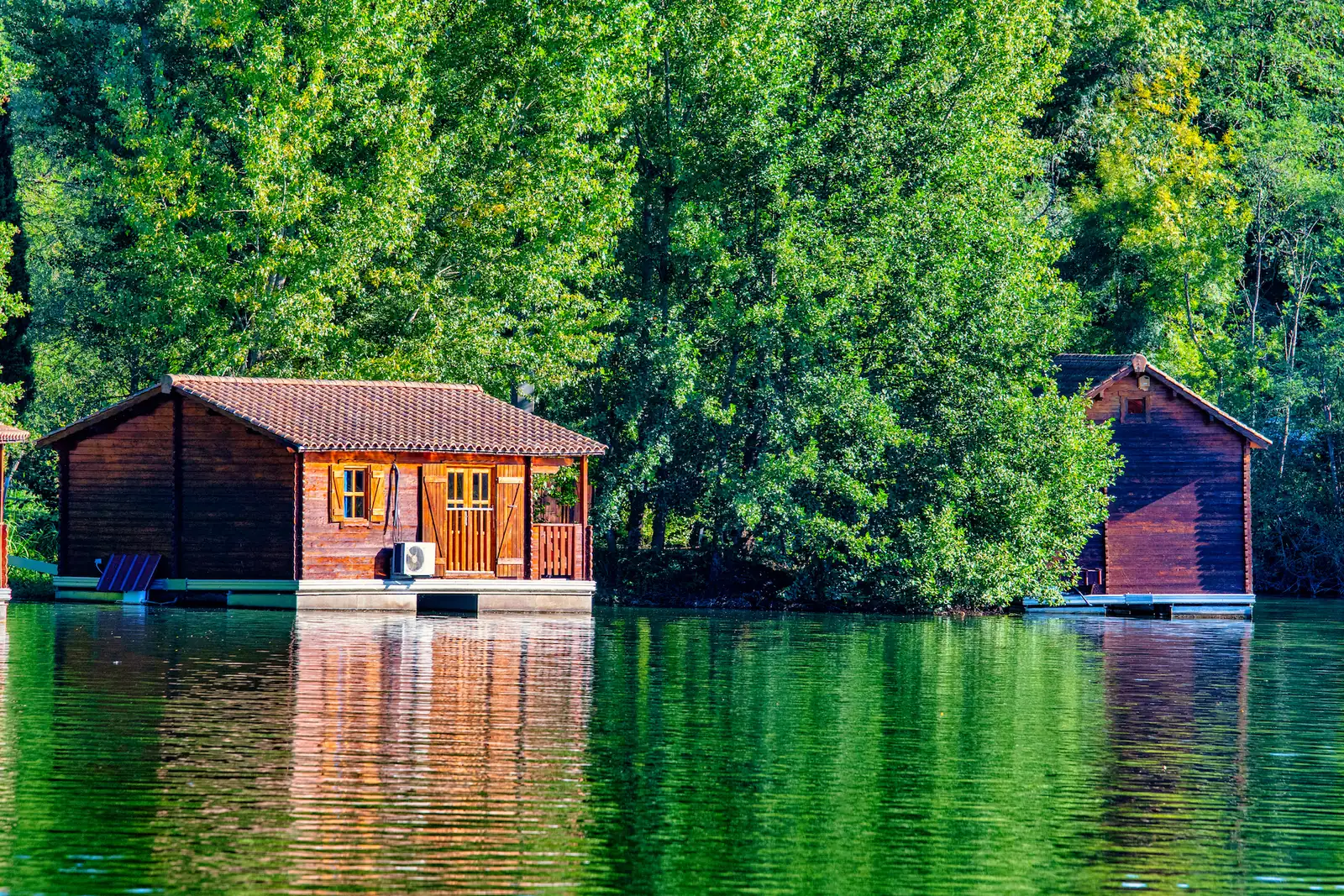
Tidal bore weekend
Sleep on the water 20 min from the wave
Floating chalet on a private lake from €110/night, 2 nights minimum. Breakfast on the terrace after the morning passage, Saint-Émilion 20 min away, Bordeaux 40 min.
Frequently asked questions
What time does the tidal bore pass Saint-Pardon? +
There is no fixed time: the wave follows the rising tide, which shifts by about 45 minutes to an hour each day. There are two passages per spring-tide day, one in the morning and one in the late afternoon. The precise 2026 times for the port of Saint-Pardon are in the table in this article (source: Vayres town hall). Arrive 30 minutes before the time shown.
What are the next tidal bore dates in 2026? +
The next notable passages (coefficient 95 and above) are 27, 28 and 29 September, 10, 11 and 26 to 28 October, 25 and 26 November and 25 to 27 December 2026. The coefficient-100-plus dates, the most spectacular of the year, fall on 20-22 March, 17-19 April, 13-15 August, 11-13 September and 27 October.
What tidal coefficient do you need to see the bore? +
The wave forms from a coefficient of around 80, becomes good from 90 and spectacular at 100 and above. Below 80 it is often barely visible. The calendar in this article only lists days where the coefficient exceeds about 75.
Where can you see the tidal bore in the Gironde? +
The best spot is the port of Saint-Pardon, in the commune of Vayres (33870), between Libourne and Bordeaux. The banks are laid out for viewing, access is free, and there is parking nearby. The wave can also be seen further upstream at Libourne, Arveyres or Saint-Jean-de-Blaignac, but it is less regular there.
Is the tidal bore dangerous? +
Not for spectators who stay on the banks. The wave reaches up to 1.4 m and travels upriver at 10-20 km/h: do not go down onto the shingle or the low pontoons, keep children away from the water's edge and keep your belongings at a distance. Surfing, kayaking and paddleboarding are for experienced practitioners only.
Where to stay near Saint-Pardon to see the tidal bore? +
Domaine du Dahu, in Sablons, is 20 minutes from the port of Saint-Pardon. Its floating chalets on a private lake (from €110 per night) let you be on site for the morning passage, often before 7am, then enjoy the day between Libourne and Saint-Émilion.
Want to see the tidal bore up close?
Stay 20 minutes from Saint-Pardon in a floating chalet on a private lake, from €110 per night. Reply within 24 hours.
Book a stay